LocalloopBKK
- Location: Bangkok, Thailand
- Year: 2024
- Work Type: Professional
- Institute / Firm: Participatory Citizen Lab
- Status: Built
- Team Members: Prapawit Intun
LocalloopBKK is a participatory AI platform developed in Bangkok, Thailand, that translates community voices into AI-assisted spatial design proposals for public space. Created by Prapawit Intun / Participatory Citizen Lab, the project combines workshops, interviews, and community engagement with a digital workflow that organizes local feedback into design categories, prompts, and spatial outputs. The platform supports collaboration between residents, designers, and policymakers through dashboard visualization, modular public-space components, and preliminary layout scenarios that respond to local conditions and resident priorities. Positioned at the intersection of participatory urbanism, civic technology, and community-centered design, LocalloopBKK explores how AI can deepen public participation by making local knowledge more legible, spatial, and actionable in urban planning.
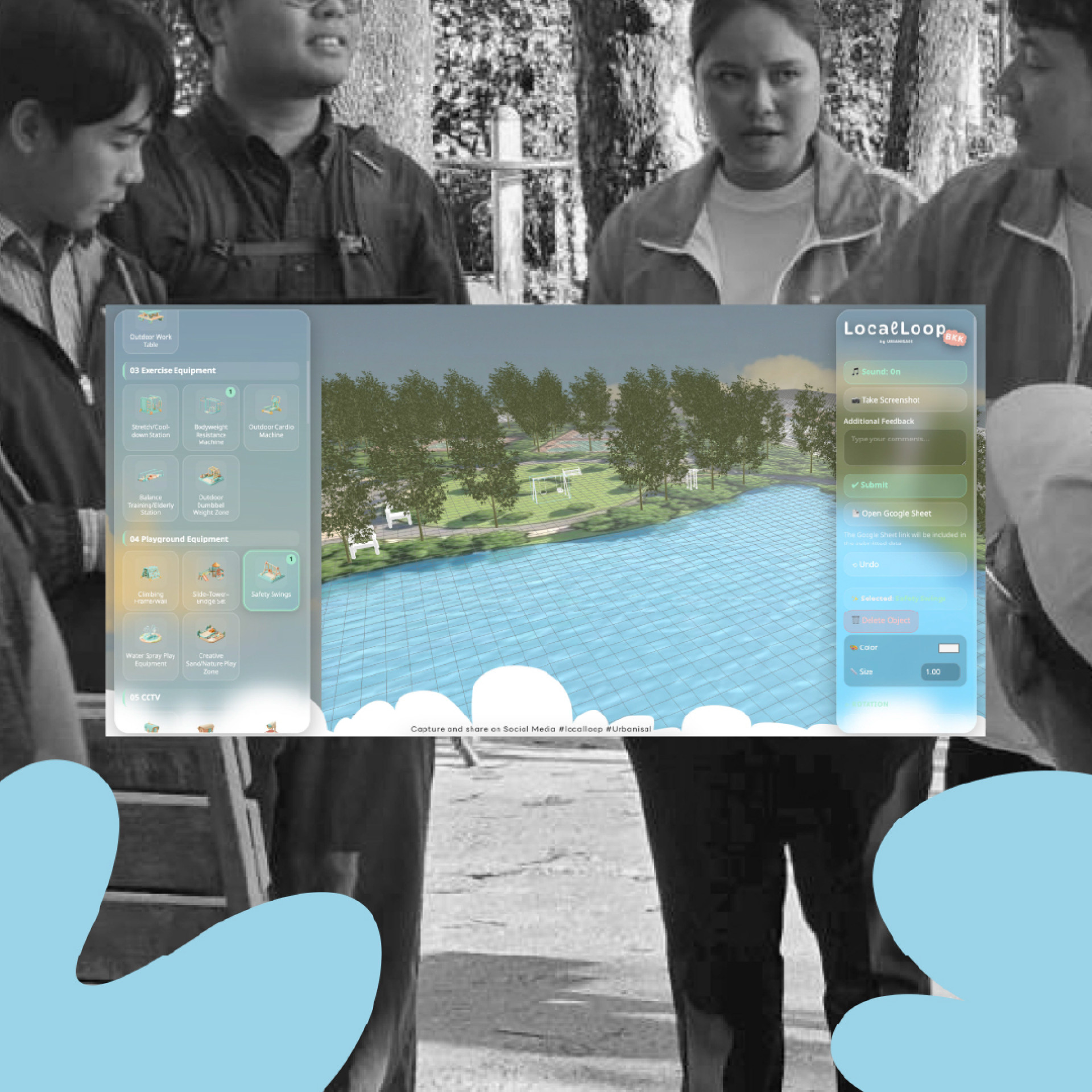 LocalloopBKK interface overlaid on a community setting, showing an early prototype of the participatory design tool in use. The image frames the platform as a bridge between lived experience and digital design, combining a public-space simulation, selectable urban elements, and a feedback panel within a real social context. By placing the interface in front of a group of people, the image emphasizes the project’s central idea: translating community voices, everyday observations, and local priorities into a visual and interactive spatial design process.
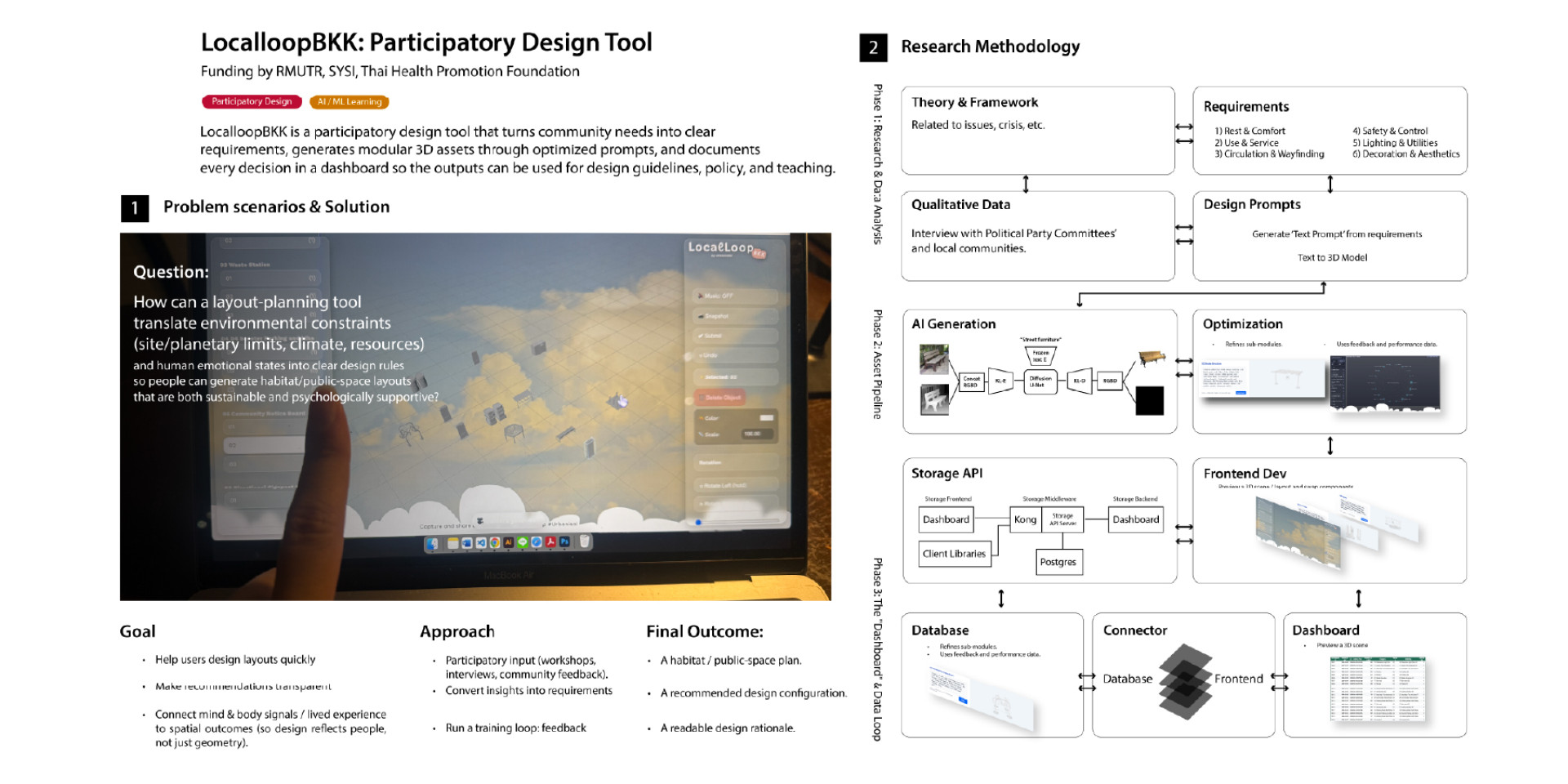 Early development of the LocalloopBKK participatory design tool, combining problem framing, research methodology, and interface prototyping into a single workflow. The image presents how community concerns are first identified through theory, interviews, and qualitative research, then translated into requirements, prompts, AI generation, optimization, storage systems, and dashboard outputs. Rather than showing only a final interface, it reveals the project as a structured design-research system that links social knowledge, technical development, and public-space decision-making.
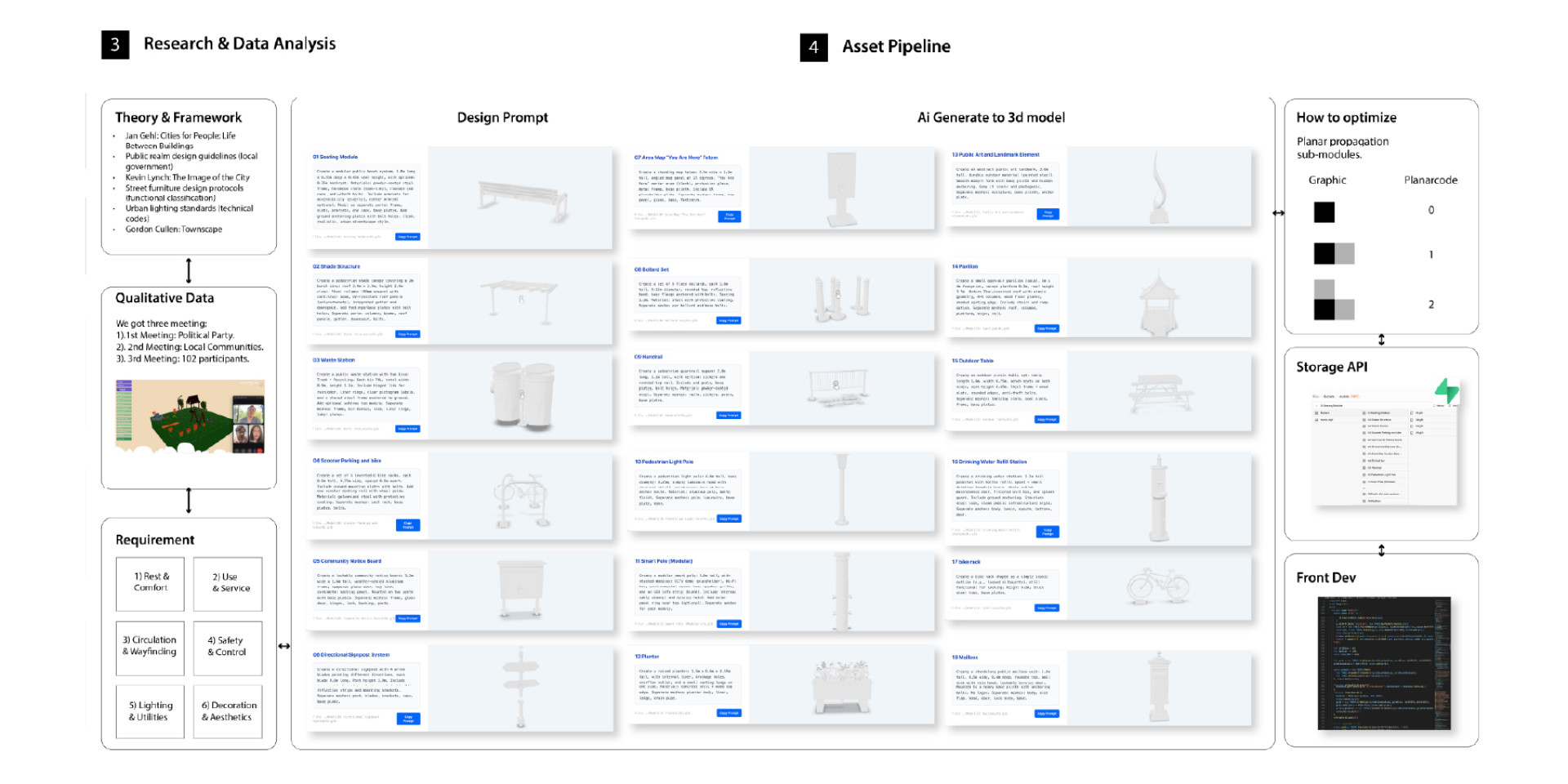 Process diagram showing how community input is converted into structured categories, design prompts, and a library of modular spatial assets for public-space generation. The image demonstrates the project’s backend logic: qualitative data and precedent research are organized into requirements such as use, circulation, safety, lighting, and aesthetics, then transformed into prompt-based outputs and 3D elements. This stage is important because it turns informal local knowledge into a repeatable design language that can support scenario-building, comparison, and future urban applications.
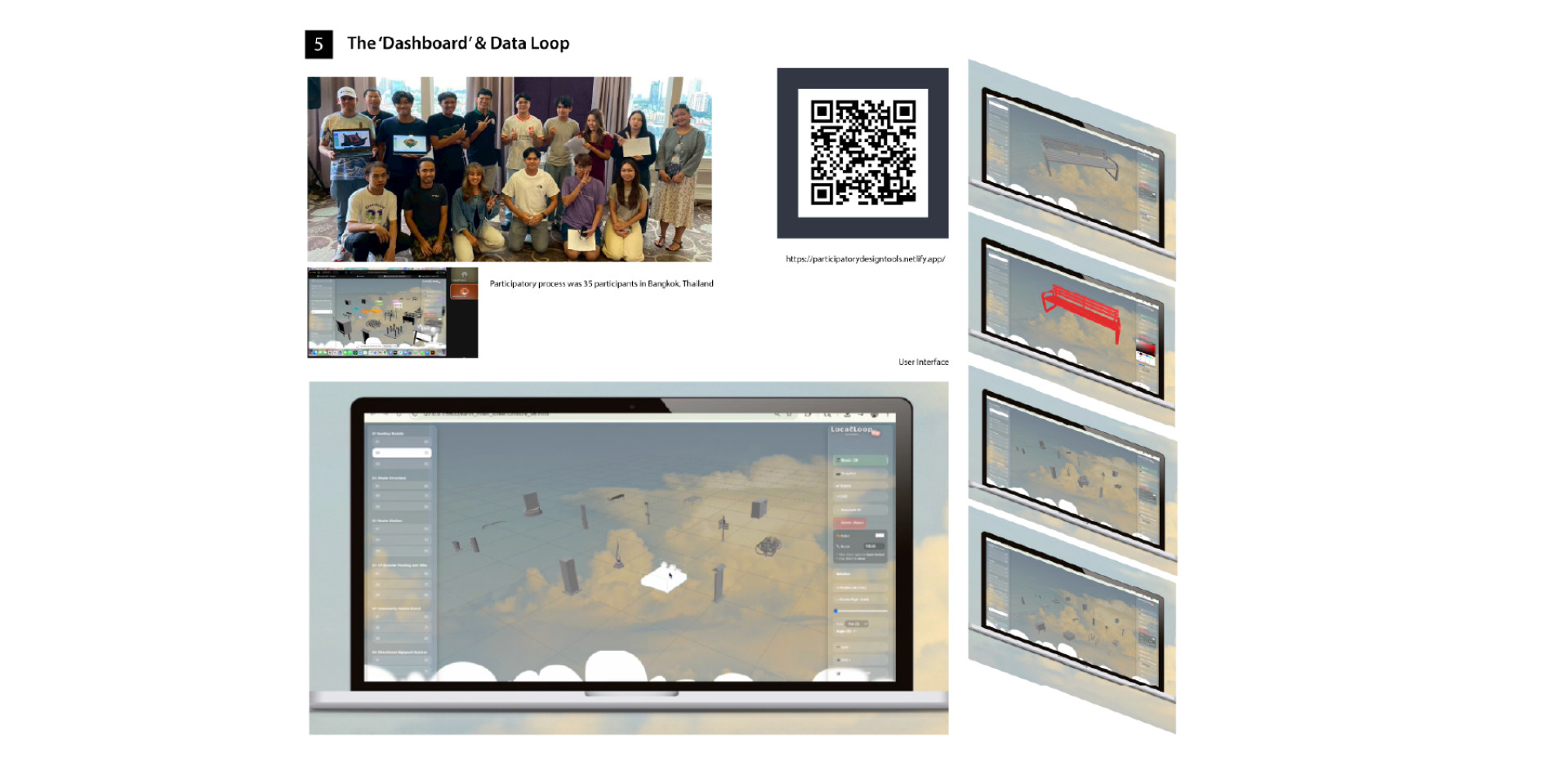 Testing phase of the LocalloopBKK platform, showing how the interface was evaluated through workshops, participant interaction, and iterative feedback. The composition combines photographs of engagement sessions, QR-based access, and multiple interface views to illustrate how local participants could interact with the platform and respond to emerging design scenarios. More than a usability test, this image communicates the project’s feedback loop: community participation informs the digital model, the model generates spatial options, and those options are brought back to people for reflection, critique, and further refinement.
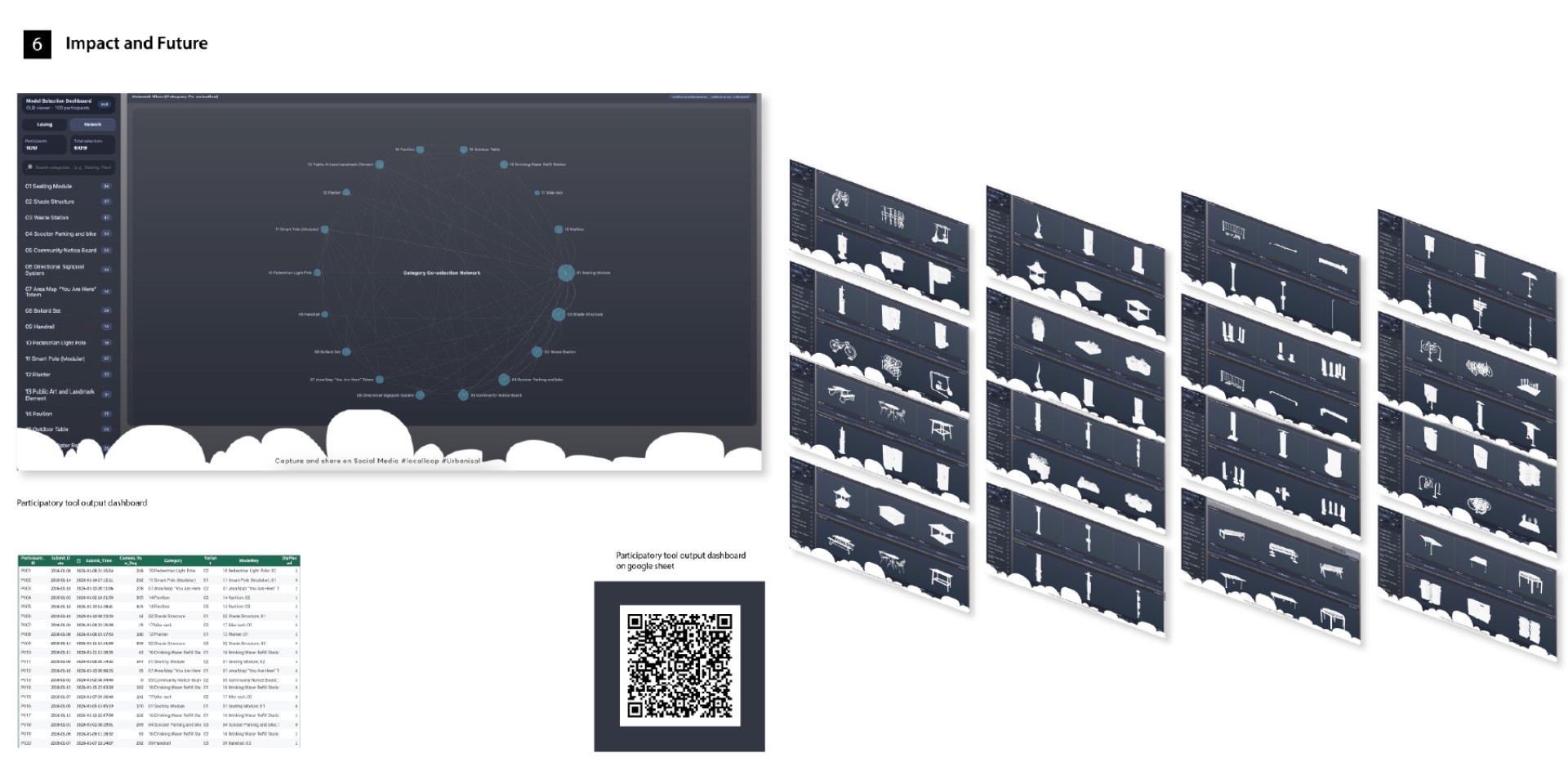 Dashboard and asset-library system developed to analyze community input and visualize potential urban interventions. The image presents a data-driven layer of the project, where participant responses are organized into an interface that can sort relationships, track recurring concerns, and connect them to families of public-space elements and design components. This stage shows how LocalloopBKK moves beyond consultation alone by creating a legible structure for interpreting local feedback and transforming it into visual, spatial, and decision-support tools for designers, communities, and policymakers.
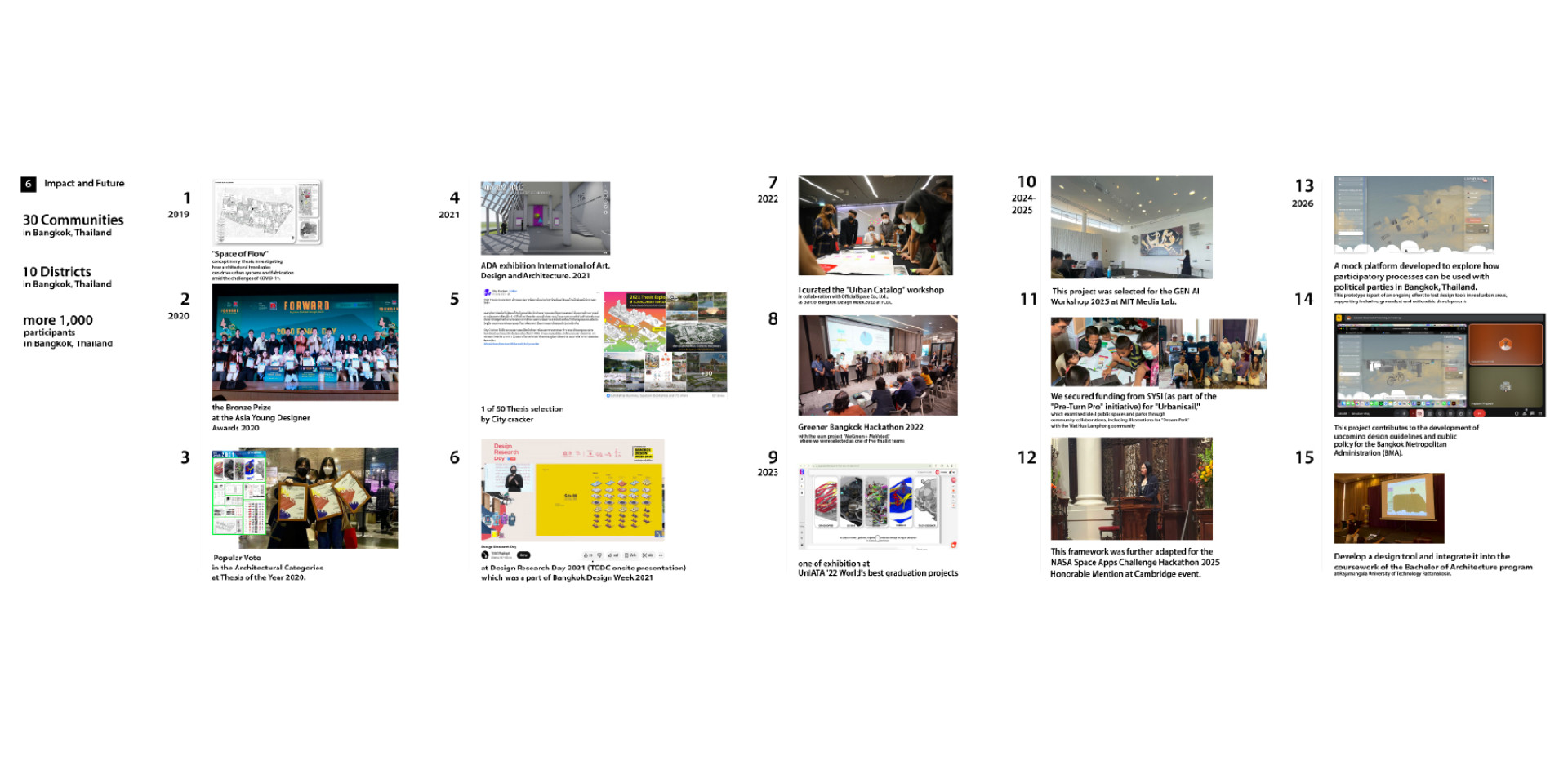 Timeline showing the evolution of LocalloopBKK through research, academic development, workshops, exhibitions, awards, and projected future implementation. Rather than presenting the project as a single finished object, the image situates it as an expanding platform shaped by multiple phases of experimentation, public presentation, and cross-disciplinary learning. It highlights how the project has grown from early investigations into participatory urbanism toward broader ambitions in civic technology, public-space design, and future urban applications in Bangkok and beyond.